

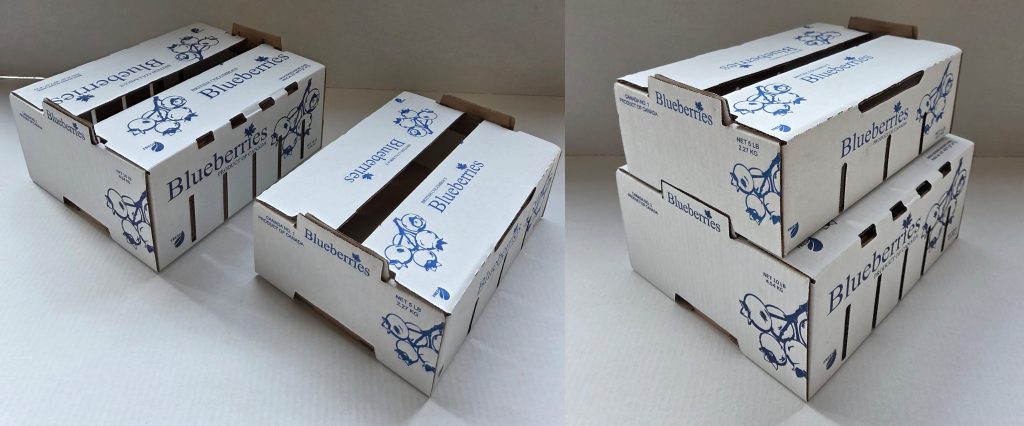
Blueberry season in Langley compresses a lot of decisions into a very short window. What might seem like small operational choices before the harvest begins tends to scale quickly once volume increases. Packaging is one of those decisions. The type of cardboard produce boxes used during the season directly affects how efficiently the fruit is handled, how well it holds up during transport, and ultimately how it is perceived by buyers and retailers.
Many farms only revisit their packaging setup when problems start to appear. Crushed berries, moisture buildup, unstable pallets, and slow packing lines are usually symptoms of a packaging system that was not designed for the realities of the operation. When the right cardboard produce boxes are in place, those issues tend to disappear before they start, because the packaging is working with the process instead of against it.
What Actually Makes a Difference in Produce Packaging
For blueberries, packaging performance is defined by a combination of structure, airflow, and handling. Corrugated cardboard boxes built with ECT32 strength provide the level of durability needed for stacking and transport, especially when pallets are built quickly and moved multiple times throughout the day. At the same time, strength alone is not enough. Without proper ventilation, even the most durable box can contribute to product loss.
This is where die-cut holes become functional rather than optional. Their placement allows air to move through the box, helping regulate moisture and temperature during storage and transport. This is particularly important for blueberries, which are sensitive to condensation and can degrade quickly if airflow is restricted. The same design also improves handling. Boxes that are easier to grip reduce drops and unnecessary pressure, which has a direct impact on product quality over the course of the season.
Another factor that often gets overlooked is consistency. When cardboard produce boxes come from the same production batch and follow standardized sizing, palletizing becomes more stable and predictable. This reduces shifting during transport and makes storage more efficient, especially in cold environments where airflow between boxes also matters.
How to Choose Cardboard Produce Boxes Based on Real Use
The right packaging choice usually becomes clear when you look at how the product moves from the field to its final destination. Instead of focusing only on dimensions or price, it helps to evaluate how the boxes will behave under real conditions:
- Harvest flow: Operations that move quickly benefit from boxes that are easy to assemble, stack, and reposition without slowing down the pace of work
- Product protection: Blueberries require a balance between capacity and depth, since excessive weight in a single box increases the risk of compression
- Ventilation needs: Proper airflow is essential to reduce moisture buildup and extend shelf life, especially during storage and transport
- Stacking stability: Consistent sizing and structural strength help prevent pallet movement and reduce the risk of collapse
- Transport distance: Longer routes increase the importance of durability and internal stability, since the product will be exposed to more handling
Looking at these factors together usually leads to better decisions than focusing on a single feature. Packaging that performs well across all these points tends to reduce losses and improve efficiency at the same time.
Where Packaging Becomes a Business Advantage
Once the operational side is solved, packaging starts to play a different role. Cardboard produce boxes are also one of the few elements that travel with the product all the way to the buyer. This makes them a subtle but consistent touchpoint for positioning.
Even simple customization, such as clean printing or consistent visual identity, can make a difference when your product moves through distributors, retailers, or direct sales channels. It signals organization, reliability, and attention to detail. In a competitive market like Langley, where many farms are producing similar products, these signals help create differentiation without changing the product itself.
There is also a growing expectation around sustainability. Corrugated cardboard boxes align naturally with this, offering a recyclable solution that fits both operational needs and market expectations. When packaging meets both performance and environmental criteria, it strengthens the overall perception of the business.
Cardboard Produce Boxes for Blueberry Farms
For farms and producers, packaging is an essential part of the operation, not just a final step. The right cardboard produce boxes help preserve quality from harvest through delivery, minimize product loss, and keep workflows running smoothly during peak season. Racer Boxes partners with businesses across British Columbia to provide durable, thoughtfully designed blueberry produce packaging that stands up to real-world conditions.
We also make it easy to order what you need so there’s no requirement to purchase a full pallet. We keep generic blueberry boxes in stock, so you can buy exactly the quantity that works for your operation.
If you’re getting ready for the blueberry season in Langley or want to improve your current packaging setup, reach out to our team to find a solution tailored to your needs.


Recent Comments